
Chemistry has a way of unearthing compounds that, over time, carve out a lasting spot in diverse fields. 2,2'-Dithiodibenzoic acid, for example, came out of the age where chemists were driven by curiosity as much as purpose. The early work on this compound traces back over a century, evolving along with the development of organic sulfur chemistry. Back then, researchers noticed how certain aromatic compounds with disulfide bonds stood apart from basic benzoic acids, and gradually, the deliberate synthesis and isolation of this specific molecule became relevant for studies involving redox reactions, ligand design, and even pharmaceuticals. This compound's history reflects that sense of scientific adventure—the sort you saw in old labs where glassware and ingenuity shaped the future.
This molecule offers more than a mouthful of syllables. 2,2'-Dithiodibenzoic acid brings together two benzoic acid groups linked by a disulfide bond. This unique structure gives it properties that are worth a closer look. On the shelf, it usually appears as a pale solid with a distinctive crystalline nature, and it has a melting point higher than many common carboxylic acids. Handling it, you immediately notice a strong odor—after all, the sulfur bridge shows up not just on paper, but in real-world sensory experience. Solubility leans toward organic solvents, where the compound acts less like simple benzoic derivatives and more in tune with other aromatic disulfides. Chemists recognize that sharp, persistent aroma, a reminder that even a small change in molecular architecture can change how a compound behaves and how it must be handled in the lab.
In research and industry, details aren’t just academic; they help us avoid confusion and keep projects on track. The exact formula, C14H10O4S2, gives away more than just the atoms—those carboxyl groups and the central disulfide bond act as points of interest in synthesis and modification. If you’re labeling a sample or documenting a process, paying attention to batch purity and moisture content helps maintain consistency. Chemists keep a close eye on spectral data—NMR, IR, and mass spectrometry—because no two preparations come out identical unless every parameter matches up. Experience taught me to always recalibrate and cross-check methods, since variables like solvent choice and temperature fluctuation can shift physical properties just enough to trip up an entire set of experiments.
Synthesizing this compound usually starts with ortho-mercaptobenzoic acid, then proceeds through an oxidation process. There’s something satisfying in watching a familiar thiol group transform into the symmetrical disulfide linkage. Common oxidants—sometimes as basic as iodine—push the reaction gently toward completion without heavy byproducts. Over the years, recipes evolved as chemists traded tips about purifying techniques. Crystallization in ethanol or similar solvents often gives a clean finish, though drying needs special attention due to the compound’s tendency to hold onto traces of moisture. Taking the time to master each step means not just a better yield but greater confidence in later applications.
The heart of 2,2’-dithiodibenzoic acid’s versatility sits inside its disulfide bridge. Disulfide bonds create opportunities for redox chemistry, making this compound a convenient starting point or model system for studying reversible bond formation, oxidative stress, and thiol-disulfide exchange. In the lab, the compound proves useful for coupling reactions, especially for tethering molecules in a predictable, reversible way. Researchers who work on polymer chemistry, catalyst design, and even pharmaceuticals keep an eye on how modifications to this core structure lead to derivatives with tailored solubilities, binding affinities, and reactivities. The carboxyl groups invite further functionalization, and you see scientists exploit these positions for directed synthesis—sometimes linking to drugs, sometimes to molecular sensors.
This compound sometimes goes by names like “dithiobenzoic acid” or more formally by its CAS number in publications. Old literature might reference synonyms rooted in German or French terminology, reflecting how early European chemists cataloged chemicals long before today’s digital databases. In my own work, I learned fast that double-checking synonyms prevented costly misunderstandings, especially in international collaborations where the same compound cycles through half a dozen naming conventions.
Working with aromatic disulfides means keeping safety front and center. There’s the unmistakable odor, a warning sign of the compound’s reactivity. Although its acute toxicity ranks lower than some sulfur-containing compounds, 2,2’-dithiodibenzoic acid still demands care—inhalation, skin contact, or ingestion carry risks, especially during weighing or mixing. Labs enforce engineering controls such as fume hoods and gloves, and anyone handling the substance learns to respect secure storage and thorough labeling. Oxidizing agents, storage temperature, and humidity get careful monitoring. Some researchers report that even small quantities can corrode metal surfaces or impart lingering smells, so materials compatibility and clean-up protocols become basic practice rather than afterthoughts.
Over time, 2,2’-dithiodibenzoic acid found jobs in places not everyone expected. In polymer synthesis, it serves as a cross-linker, stabilizing the connections between polymer chains by forming disulfide bridges that switch between stable and cleavable states under certain conditions. In biochemical research, it acts as a model disulfide for enzyme studies or as a reagent in redox cycling—crucial for researchers looking into protein folding or oxidative stress in cells. Metallurgists experiment with this compound as a ligand base, building coordination complexes for catalysis or material science. In electronics, the molecule’s ability to bridge components using sulfur chemistry sparks interest in nanoassembly and sensor platforms. Every field values different aspects of the molecule’s personality, from its ligand properties to its reactivity and mechanical stability.
Chemistry laboratories continue to turn to 2,2’-dithiodibenzoic acid when developing new reactions and probing old theories. Academic researchers dig deep into the kinetics of thiol-disulfide exchange, exploring what happens when you push or pull electrons in different solvents. R&D groups, focused on materials, use it as a launching pad for designing redox-active polymers and surface modifiers. There’s even current work mapping out how this—even in small quantities—affects metal ion binding, corrosion inhibition, and as templates in nanostructure synthesis. Each of these efforts tests the limits of what can be achieved when researchers combine practical lab skills with a willingness to ask bigger questions about molecular design.
Knowing a compound’s toxicity doesn’t just protect researchers, it also shapes policy and practice for disposal and workplace exposure. Studies show that 2,2’-dithiodibenzoic acid hasn’t led to major health scares, but its handling still raises serious questions. Chronic exposure, even at low levels, can lead to skin and respiratory irritation or longer-term health issues if ignored. Waste solutions and residual solids don’t belong in standard drains—specialized protocols for sulfur-containing waste keep environmental impacts in check. As someone who’s watched research evolve, I see more journals asking for full disclosure on handling and disposal, not just lab techniques and yields.
The future for 2,2’-dithiodibenzoic acid holds real promise as new challenges emerge in both applied and fundamental science. Increasing demand for responsive, reversible chemical linkages in advanced materials pushes chemists to reconsider old standards through a modern lens. Growing interest in green chemistry suggests the need to develop cleaner, safer synthesis routes and disposal practices. As research into biological disulfide chemistry ramps up, compounds like this one may inspire innovation in controlled drug delivery, recyclable materials, and smart sensors. With every new paper, the story of 2,2’-dithiodibenzoic acid gets another chapter, proving again that the journey of a chemical never really ends.
Ask a seasoned chemist about 2,2'-Dithiodibenzoic Acid, and the reaction often surprises people from outside the lab world. Most folks wouldn’t recognize the name, yet this compound plays a key part in tasks that stretch far beyond textbook exercises. From my own days at the university lab bench, I remember its slightly pungent smell and tricky texture—yet its uses stuck in my mind because of just how far its influence travels into industries you might not expect.
This organic compound carries a mouthful for a name, but its strength lies in the sulfur-sulfur bond that gives it a knack for bridging molecules. This isn’t academic trivia. The whole field of polymer science leans on crosslinking agents to toughen up materials or tweak how they stretch and bend. 2,2'-Dithiodibenzoic Acid isn’t as famous as some other crosslinkers—like glutaraldehyde or even sulfur in vulcanized rubber—but it offers a chemist notable control over the resulting material tweaks.
In the specialty plastics world, tweaking flexibility or durability brings out quality differences. Without crosslinkers, some gels or specialty adhesives break down too quickly or lose their shape under stress. This compound lets researchers adjust those features at a molecular level, tuning how polymers react to heat or solvents. Imagine materials in medical devices or coatings that must withstand harsh hospital disinfectants. The right crosslinker determines if those products stand the test of time.
My own research once led me to look at how certain protein disulfide bonds form or break—a process central in biochemistry. 2,2'-Dithiodibenzoic Acid helps labs measure and probe those bonds. By reacting with thiol groups (think cysteine residues in proteins), it acts like a spotlight for researchers testing enzymes or tracking protein folding. Without reliable reagents, experiments drag on or lose accuracy. Researchers use this compound to ensure test results nail the right target, not just some background noise.
Analytical chemists also take advantage of this property. For folks running HPLC or spectroscopy, it helps highlight or detect sulfur-containing molecules in complex mixtures. This isn’t an everyday use for the average person, but in the world of drug discovery or environmental analysis, precision tools like this make bad data less likely and keep mistakes from climbing up to expensive regulatory problems.
Nothing used in the lab comes without headaches. 2,2'-Dithiodibenzoic Acid brings some handling concerns—its sulfur content means it can irritate skin and airways. My lab friends took this seriously, even double-gloving if they expected a spill. There’s also waste. Organosulfur waste can’t go down the drain; it demands proper disposal, especially in scales larger than the classroom.
Labs and companies need to pay attention to both everyday safety and long-term impact. Investing in better containment systems and better waste neutralization techniques can keep the benefits without piling up risk. Green chemistry ideas already push researchers to look for less hazardous alternatives or smarter recycling approaches. Every step toward cleaner handling connects directly to safer workspaces and less environmental stress.
The story of 2,2'-Dithiodibenzoic Acid isn’t just about obscure chemistry. It shows how seemingly minor players can shape the speed, safety, and innovation of research that touches modern medicine, manufacturing, and the analytical sciences. The quiet presence of this compound in polymer labs and research projects makes a good reminder: sometimes, the unsung chemicals push the boundaries forward, demanding respect for both their utility and their challenges.
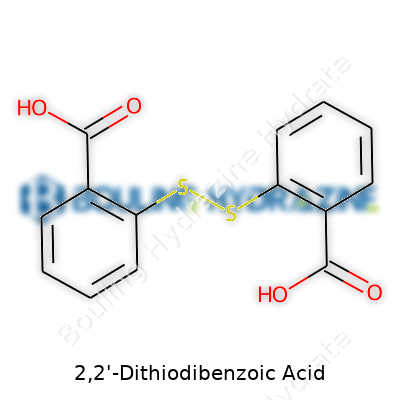
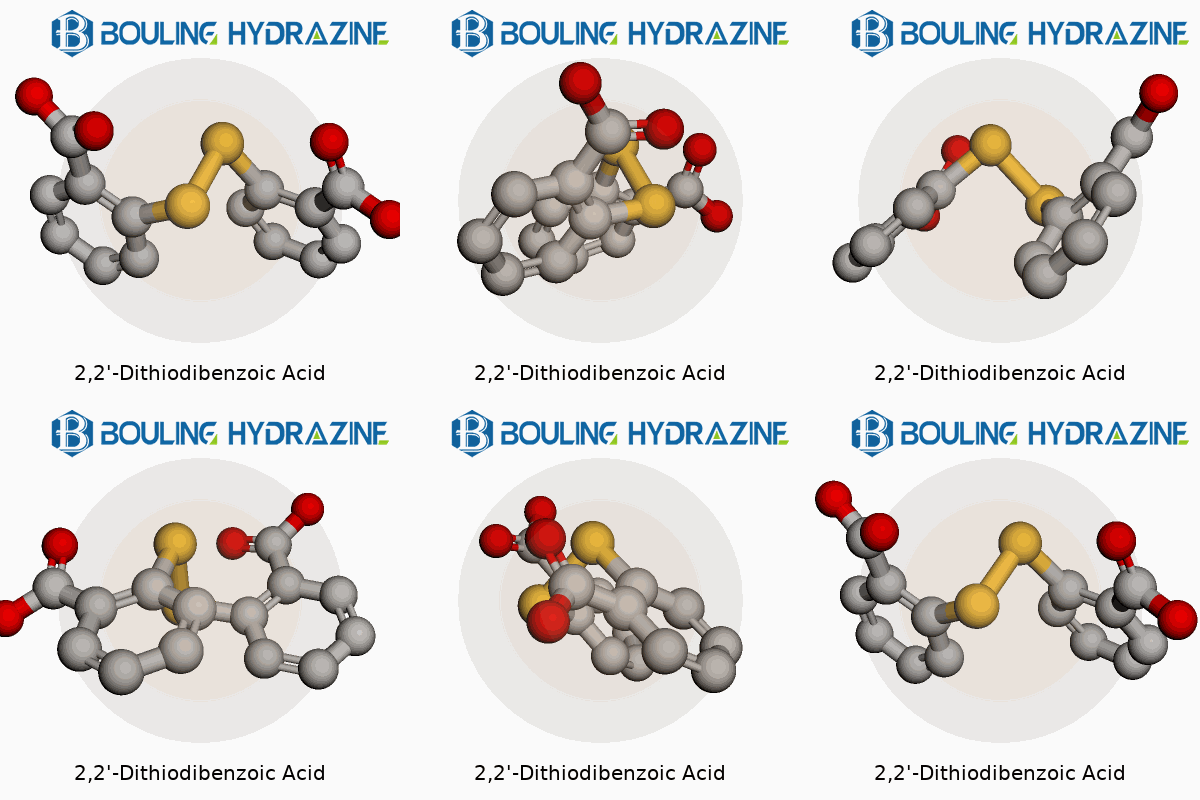
In the world of lab work, recognizing the twists and turns of a chemical's structure can make or break an experiment. Take 2,2'-Dithiodibenzoic acid as an example. This mouthful of a name belongs to a compound that's more than just a jumble of atoms. At its heart, two benzene rings sit side by side, each carrying a carboxylic acid group. What links them is a sulfur-sulfur bond, a disulfide connection, tying the structures at their second positions. It reads almost like a handshake between the rings, making the entire molecule quite special.
This particular bridge—the disulfide bond—crops up again and again in important biological molecules, most famously in proteins where it helps craft structure and stability. Chemists pay close attention to where these sulfur bridges pop up because they’ll shift the reactivity and the stability of an entire compound. Here, the acid groups on each benzene ring just add to the story. They're known for being active in chemical reactions, often sticking onto metals or chipping in when a chemist needs to build something larger or more complex.
Even for those who’ve never paid much attention to organic chemistry, the design of 2,2'-Dithiodibenzoic acid impacts real-world outcomes. It matters for anyone invested in protein chemistry, pharmaceuticals, or even environmental monitoring. That unusual structure—rigid framework and reactive sites—offers a stable platform for building more complex molecules. Researchers exploit its disulfide bridge when they need to make reversible links. This isn't just theory; that bond lets scientists connect and disconnect parts of a system with precision, an ability that's crucial for building drug carriers or finding new diagnostic tools.
One common lab memory: working with molecules that seemed simple on paper, but acted slippery or unpredictable in a flask, purely thanks to the way atoms lined up. 2,2'-Dithiodibenzoic acid surprised me with its hardiness. Even with heat or stirring, the disulfide connection held strong—up to a point. It was only with a targeted dose of reducing agent that the bond willingly broke, splitting into two mercaptobenzoic acid molecules. That sort of predictability can save weeks of trial and error in the field. And for those in manufacturing, knowing exactly how a structure behaves means fewer costly surprises when reactions scale up.
As labs continue pushing towards greener, leaner chemistry, understanding the building blocks still makes all the difference. Chemistry textbooks might make structure sound theoretical, but no one can skip these details and expect progress later, especially with new drugs or diagnostic tools. Environmental testing relies heavily on molecules that remain stable or break apart as needed—and a finely-tuned structure supplies that level of control. Even policy gets shaped around what chemical structures can or can’t do in the environment.
Digging into the makeup of 2,2'-Dithiodibenzoic acid highlights something the field can't forget. Chemistry’s real value unfolds not just in stunning discoveries but in the everyday ability to rely on what’s known about atomic connections. The clarity of a structure like this one forms the base for safer materials, smarter processes, and breakthroughs still waiting on the horizon. Anyone committed to innovation does well to start by really seeing what ties their molecules together—for those sulfur-linked rings, the payoff has proven itself time and again.
Ask anyone who’s ever worked their way through a small mountain of chemical bottles in a shared laboratory: the attention you pay to storage and handling matters more than most realize. 2,2'-Dithiodibenzoic Acid might not sound threatening, but it comes with its own set of quirks worth respecting. So let's get real about how to keep people—and the material—safe.
Walking into a poorly ventilated stockroom and catching a whiff of chemical residue always gives me pause. No one wants to get careless, especially with organic disulfides like 2,2'-Dithiodibenzoic Acid. It’s a compound with known irritant properties. Let it dust up your workspace or hands, and you’ll probably remember that lesson for a while. So, working with gloves and safety glasses becomes more of a habit than a chore. Skin contact is no joke, considering repeated exposure can lead to dermatitis or worse.
Spills and residue—tiny, avoidable accidents—turn into headaches. It's remarkable how quickly a bit of uncontained powder can migrate over benches, lab books, and anything nearby. From years in the lab, labeling containers, tightly sealing lids, and wiping surfaces before and after each use are habits that save loads of clean-up time, not to mention health risks.
Years ago, I saw what happens when heat gets to certain compounds. A simple uptick in room temperature can push chemicals to react, decompose, or clump into a mess. 2,2'-Dithiodibenzoic Acid does best in a dry, cool place, away from light. Light can trigger changes in certain sulfur compounds—you'd rather not see what happens to purity or, worse, stability. I trust opaque or amber-glass bottles more than plastic or clear glass for longer-term storage.
Anyone who has shared a fridge or chemical cabinet knows the chaos a disorganized shelf can create. Deco, half-used vials and mixing containers run the risk of contamination, which jeopardizes future reactions and data. A steel cabinet marked for corrosives, isolated on a shelf well above acids or bases, brings order and cuts down on cross-contamination. Especially because sulfur-containing acids might not play nicely with some strong oxidizers or bases.
Workplace safety doesn’t come from compliance alone. It comes from daily habits: inspecting containers before each use, checking for dryness and clumping, shaking lightly to break up cakes if needed but not overhandling the bottle. Restocking and inventory help avoid forgotten, decomposed samples hiding at the back of the shelf. I’ve seen a few labs add moisture-absorbing packets to the primary bottle—an inexpensive layer of protection.
Training is often undervalued. New students sometimes treat chemical names as trivia, forgetting that knowing what irritates skin, eyes, or lungs can keep them healthy. So, regular walk-throughs about where to store specific compounds or demonstrations of safe transfer techniques help lower the odds of mishaps. Laminated reminder cards or straightforward signage on storage cabinets go a long way.
From experience, digital tools now help manage stocks and prompt regular checks. Software notifications remind us when to review shelf lives and storage standards. 2,2'-Dithiodibenzoic Acid might not be the riskiest chemical in any lab, but giving it the attention it deserves lets teams focus on their research instead of crisis responses. Sometimes, old-school habits—like a roll of tape for clear labels and a clipboard checklist—do just as much as fancy systems. Keeping it simple and consistent keeps people safe.
Most people outside labs or specialized manufacturing probably haven’t heard of 2,2’-dithiodibenzoic acid. For researchers, it’s a go-to compound for linking molecules through disulfide bridges, and you’ll spot it in a number of chemical synthesis texts. The bigger question for anyone working with it or living near places that use it: Is this chemical dangerous, and are its risks being respected?
Reports tie 2,2’-dithiodibenzoic acid to irritation in eyes, skin, and the respiratory tract. There aren’t broad studies on people, but similar compounds remind us to tread carefully. Chemists working at the bench quickly learn the lesson that even small molecules—especially ones with aromatic rings and sulfur bridges—can cause trouble. I’ve noticed gloves and proper ventilation become non-negotiable, not only to tick off boxes, but because short exposures sometimes leave noses stinging or skin red from splashes or vapors. If any chemical irritates those areas, it’s wise to ask what happens with larger doses, chronic exposure, or accidental ingestion.
Animal studies on related aromatic acids with sulfur often show low to moderate acute toxicity but raise flags about long-term risks. Though no major carcinogenic threat has been documented for this compound, not all chemicals get an equal share of research. One thing is certain: repeated or heavy exposure is never a good gamble. Sulfur-containing organics sometimes slip through old building drains and end up in the water table, which can spell trouble for local ecosystems. That’s not just a lab issue; anyone downstream of a manufacturing plant should care about this.
Across chemical industries, everything hinges on how people handle and store materials. Many regulators classify compounds like 2,2’-dithiodibenzoic acid as hazardous due to irritation potential and possible environmental impact. In practice, good labeling, fume hoods, sealed containers, and hazardous waste management must replace sloppy habits that defined part of chemical history—not just because inspectors demand it, but because the stakes include health and the environment.
The decades of stories from chemists about accidental spills or splashes still echo around lab safety trainings. A former colleague once recounted a minor eye splash with an aromatic acid, which—even with thorough rinsing—left him nervous for days. After that, no one in the lab skipped full-face protection when pouring aromatic organics with sulfur.
Some folks ask why we don’t just switch to something “safer.” Usually, the answer is that alternatives come with their own baggage: different hazards, higher cost, or no real drop in risk. What makes a difference is honest risk assessment paired with better engineering controls. Regular audits, accessible safety data, and staff who feel empowered to report problems all play more of a role than simply posting hazard signs.
Proper waste disposal matters, too. A quick and dirty pour down the sink can’t be allowed, given the risk to both public health and the environment. Modern chemical companies have come a long way since the era of chemical dumping, but it only takes one manager cutting a corner to set things back years.
Anyone who works with 2,2’-dithiodibenzoic acid needs clarity on its risks and a commitment to handling it with care. The story of chemical safety in our time grows out of lessons learned the hard way: respect what you work with, keep the community informed, and you’ll sidestep most disasters before they even have a chance to start.
Most chemists who have juggled organosulfur compounds know the headaches involved in dissolving 2,2'-Dithiodibenzoic acid. This molecule brings something special to the table: a large, sulfur-bridged aromatic structure. It’s not just another benzoic acid derivative. Anyone who’s tried to dissolve it in water learns quickly that it’s a real challenge.
The carboxylic acid groups might look water-friendly at first glance, but the two big benzene rings and the disulfide bond set up a barrier. That means this acid has a strong grip on its own crystals, refusing to let water molecules break them apart. Honestly, tossing it in a beaker of water and expecting a clean solution just wastes time and resources.
Instead of pushing against that wall, many chemists move straight to organic solvents. Polar aprotic solvents like dimethylformamide (DMF) and dimethyl sulfoxide (DMSO) open doors. These solvents can slip between the aromatic rings and help the molecule dissolve. Solvents like acetone, ethyl acetate, and even chloroform often get the job done faster, more reliably, and without the hassle.
This isn’t just about convenience. In practice, if a researcher needs a clean thiol-disulfide exchange or tries to synthesize metal complexes, starting from a proper solution is the only way to hit meaningful yields and consistent quality. Trying these transformations in water usually primes the chemist for disappointment and wasted batches. Organic solvents not only dissolve more of the compound, but also maintain chemical integrity by avoiding unwanted hydrolysis.
It’s easy to take solubility for granted, but it shapes everything. With 2,2'-Dithiodibenzoic acid, understanding behavior in different solvents often saves projects from delays and dead-ends. Peers can vouch for long hours lost on ambitious water-based experiments that ended with little more than frustrated sighs and cloudy suspensions.
Crystal structure and molecular interactions aren’t just academic conversations. Industry and academic labs run up against them with every synthesis, every purification. Techs in pharmaceutical development, for instance, see how poor water solubility can complicate both reaction efficiency and downstream separation. This isn’t trivial, since time lost in troubleshooting eats away at limited research budgets and rushes critical innovation.
Over time, researchers who stick with organosulfur chemistry learn from each other’s mistakes. Lab notes and published protocols now clearly recommend starting with DMSO or DMF, sometimes with a touch of mild heating to kickstart the process. Simple strategies like sonication or slight warming can turn a gritty suspension into a manageable, clear solution.
Some folks experiment with salts or mixed-solvent systems to nudge more of the acid into solution, but these workarounds require testing and a close eye on how additives might change the final chemistry. No one enjoys tossing a promising reaction because a solvent tweak introduced new side products.
In the end, success often doesn’t rest on buying fancier glassware or shifting to more expensive chemicals, but in sharpening solvent choices and learning from experience—yours and others’. It’s that blend of practical wisdom and honest trial and error that keeps good chemistry moving forward.

Providing high-quality chemical products and logistics solutions for global trade partners.



