
Few people outside of specialty chemical circles recognize the evolution that has led N,N-Dimethylallylamine from obscure curiosity to valued chemical intermediate. The story begins sometime after the initial synthetic boom in organic chemistry, when chemists set their sights on finding small molecules that could bridge the gap between simple aliphatic amines and more complex functionalities. Researchers realized that tweaking methyl groups onto common allylamines brought about interesting changes in reactivity, volatility, and usability. Over the past fifty years, as chemical manufacturing techniques improved, accessibility and consistency of this compound have improved right alongside demand. Rather than remaining a niche lab reagent, it found a foothold in industrial processes spanning adhesives, pharmaceuticals, and specialty polymers.
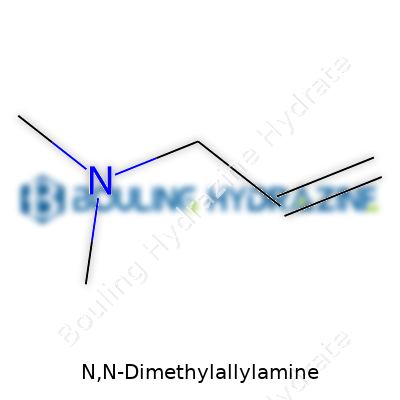
Most folks don’t walk into their local store and see a bottle labeled N,N-Dimethylallylamine on a shelf, but anyone who works in specialty manufacturing, research, or pharmaceuticals recognizes that odd chemical name. The compound presents itself as a colorless to slightly yellow liquid, often with a distinctive, sharp odor typical of aliphatic amines. Its defining feature—an allyl group bound to a nitrogen that holds two methyl groups—offers a set of chemical “handles” for downstream modification. This versatility explains why so many research chemists pick up the molecule when they want to toss a reactive nitrogen into their latest project, or why it keeps popping up in patents covering next-generation functional materials.
N,N-Dimethylallylamine stands apart for its low boiling point and high vapor pressure. The molecule has a knack for escaping into the air under standard conditions, so industrial handlers often pay extra attention to venting and containment. Its structure—a tertiary amine attached to an allyl group—enables it to act as a nucleophile with a bias towards certain alkylation reactions. Solubility appears especially intriguing, straddling the line between polar and nonpolar environments, so it dissolves readily in water but also mixes easily into organic solvents like dichloromethane and ethanol. Its reactivity hinges on the combination of a basic nitrogen and a terminal double bond, a pairing that doesn’t often come together in the broader world of commodity chemicals.
Specifications present more than just numbers on a technical sheet. In practice, labs and factories ordering N,N-Dimethylallylamine want to know about purity, water content, and the absence of problematic side-products. Contaminants like residual dimethylamine or formaldehyde show up as troublemakers that can spoil sensitive syntheses. Suppliers typically offer this compound in sealed containers made of glass or high-density polyethylene to prevent slow evaporation or reactions with atmospheric carbon dioxide. Labeling regulations push for clear hazard statements, signaling the potential for vapor toxicity and the need for careful storage. Transporting or storing this chemical isn’t the kind of task left to chance; even seasoned staff rely on up-to-date documentation and strict handling protocols to avoid unwanted incidents in labs and warehouses.
The road to N,N-Dimethylallylamine starts with choosing good precursors. In the industrial setting, the process often relies on the alkylation of dimethylamine with allyl chloride, a reaction famous (or infamous) for exothermic surges and side-product headaches. Chemists keep a close watch on temperature, dosage, and extraction to prevent runaway reactions or formation of nasty byproducts. Solvent choice can shift yields from passable to outstanding—toluene, for example, works because it dissolves both the reactants and the product, but doesn’t participate in the chemistry. Purification typically involves careful distillation, since the target compound boils away long before many less-volatile side-components. Even in well-established facilities, yield improvements come from constant troubleshooting and creative process tweaks that separate the reliable producer from the also-ran.
Few small molecules offer the balance of reactivity and stability seen with N,N-Dimethylallylamine. The amine group welcomes alkylation, giving rise to quaternary ammonium salts used in antistatic agents and surfactants. The double bond opens doors to polymerization, hydroamination, and cross-coupling experiments. Industries chasing novel ion-exchange resins or bioactive agents keep a close eye on this chemistry, since minor tweaks to the molecule can trigger big shifts in performance. The challenge lies in tuning conditions so that desired transformations outpace side reactions—especially since the allyl group’s inherent reactivity can tempt unwanted additions from rogue reagents or environmental contaminants.
Markets and research papers sometimes muddy the waters with a tangle of alternate names. You might see N,N-Dimethyl-2-propen-1-amine, 2-Propen-1-amine, N,N-dimethyl-, or even DMAA for short. No matter the label, the core compound remains the same—a tertiary amine tethered to an allyl group. That patchwork of names can cause confusion, especially for less-experienced buyers or students picking up published procedures. Sifting through synonyms calls for a careful eye, as naming inconsistencies or errors can derail a chemical order or botch a synthesis.
Safety guidelines for N,N-Dimethylallylamine have grown far more rigorous as researchers catalog the risks. Its fumes can burn the eyes and lungs, and accidental spills make for rapid emergency responses. Modern operations require staff to wear gloves, goggles, and often a respirator, and every facility keeps spill kits and ventilation hoods within arm’s reach. Accidents involving tertiary amines often go beyond a simple cleanup—lingering vapors or surface residues can harm people returning to a space even hours later. Organizations like OSHA, REACH, and local regulatory bodies put forward specific limits on exposure, and real-world compliance means regular air sampling, training drills, and spot-checks to keep standards out of the theoretical and anchored in daily routines.
The utility of N,N-Dimethylallylamine tracks the evolution of the specialty chemicals sector. Factories churn out cationic polymers for use in water treatment, paper manufacturing, and even cosmetics. In my years consulting for industrial clients, I’ve seen how this amine slips seamlessly into both bulk and boutique chemical lines—all shaped by its ability to anchor molecular structures or tweak physical properties. Pharmaceutical developers lean on it as a building block, exploiting its amine and alkene functionality to stitch together complex targets. In the adhesives and coatings worlds, it helps introduce crosslinking sites that toughen up everything from automotive parts to consumer packaging. Across these applications, the common demand is for precise, reproducible reactivity—something the allyl-dimethylamino structure delivers consistently, provided the supplier maintains high quality.
Academic groups and industrial R&D teams regularly probe the frontiers of what’s possible with N,N-Dimethylallylamine. Recent years have brought a surge of interest in sustainable chemistry, prompting efforts to develop new catalytic systems that work with this amine under milder, less wasteful conditions. Polymer scientists chase after new monomers that pair with the allyl-amine structure, aiming to launch smart materials that respond to light, heat, or pH fluctuations. Analytical researchers continually improve the detection and quantification of trace amines in pharmaceuticals and food products, where small differences in amine content can make or break regulatory approval. Many discoveries in this space begin with a hunch or a lucky accident in the lab, then move rapidly into wider industrial practice as teams scale up and optimize. Every breakthrough has a direct human impact—cleaner water, safer pharmaceuticals, or more efficient industrial processes—creating a feedback loop that draws fresh talent and ideas into the field every year.
Toxicologists pay close attention to N,N-Dimethylallylamine because of its volatility and chemical structure. Studies point to risks from inhalation or skin absorption; anyone who’s cracked open a lab bottle knows how quickly the vapors affect eyes and upper airways. Animal and cell studies capture dosage-dependent effects, helping regulators set exposure limits and guide industrial practice. Chronic exposure, even at seemingly low levels, can trigger organ stress or nervous system symptoms over time. Most industries—having learned from past incidents—now favor real-time air monitoring, periodic health checks, and closed-system operations to keep worker risks as low as possible. Ongoing research still investigates long-term effects and potential carcinogenicity, especially since the molecule finds its way into finished goods as both a residual and a building block. Precautions extend beyond the production floor—disposal and effluent treatment methods must ensure that none of the compound or its breakdown products leach into groundwater or pose risks to communities.
Looking ahead, N,N-Dimethylallylamine appears poised for ongoing, if sometimes overlooked, growth. Emerging green chemistry techniques may further trim the environmental impact of both its synthesis and applications. As the drive for recyclable and adaptive materials accelerates, chemists keep the unique reactivity of this amine in their toolkit for everything from cleaner catalysts to responsive hydrogels. More sectors call for specialty amines as regulatory scrutiny on other chemical categories tightens and the push for alternative, less-hazardous chemicals gathers steam. The next wave of research will tackle both safety and sustainability—questions about life-cycle analysis, renewable feedstocks, or low-energy manufacturing routes demand answers beyond what worked in the past. N,N-Dimethylallylamine hides in plain sight: a small molecule at the crossroads between legacy chemistry and future innovation, waiting for the next group of researchers to redefine its role and meaning in both science and industry.
Many folks don’t hear about N,N-Dimethylallylamine outside of a chemistry classroom or technical lab, but the jobs this molecule carries out touch more lives than you might think. In my years watching changes in the chemical industry, this compound continues to prove its worth as a versatile building block that finds its way into core products, sometimes quietly, sometimes as the key to making something even better.
N,N-Dimethylallylamine shows up most often in the creation of other chemical compounds. Its structure lends itself to making specialty chemicals, often acting as a core intermediate that takes part in reactions to help create a variety of products. For example, the chemical forms part of the backbone in the synthesis of quaternary ammonium compounds, which play a critical role in the world of water treatment. Towns and cities depend on clean water, and those quaternary ammonium compounds, made in part from N,N-Dimethylallylamine, help kill bacteria and keep contaminants at bay.
Beyond water treatment, this compound gets pressed into service for producing surfactants. Surfactants make everyday products — like soaps, detergents, and shampoos — do a better job by letting water mix with oils and dirt so cleaning works the way people expect. These same chemical properties also make it useful in antistatic agents added to plastic products, stopping static shocks that can damage electronics or give you an unwanted zap at the wrong moment.
Farmers have seen chemicals like N,N-Dimethylallylamine turned into plant protection agents that keep food crops healthy and boost yields. Pesticides and herbicides need precision to target pests without risking harm to people or the environment, and this compound’s flexibility allows chemists to fine-tune molecules for that purpose. Without advances like this, farmers would face far higher losses and food costs could skyrocket.
It hasn’t escaped the notice of pharmaceutical companies either. Some research uses N,N-Dimethylallylamine as a starting point for drug molecules that eventually reach the doctor’s office or pharmacy shelf. It doesn’t end up in the tablet you swallow, but without it, the process of crafting complex drug molecules stalls at square one.
On the flip side, there’s a need to pay attention to the health and environmental risks that come from chemicals like these. Strict rules control its transport, handling, and disposal. Experience shows that while these chemicals enable progress, their benefits only come when manufacturers mind safety from start to finish. Responsible companies invest in closed systems to control leaks, and workers use tough personal protective gear to keep exposure low. Regulators check records, inspect plants, and occasionally surprise companies with spot audits — all in the name of public and environmental health.
Better science keeps finding ways to reduce waste and smarten up the process. Some teams invest in greener chemistry, tweaking old recipes to use fewer hazardous ingredients, recycle solvents, and lower emissions. This isn’t just good for the planet — it saves money, and those savings can mean lower prices down the road for everything from shampoo to circuit boards. Looking ahead, progress depends on a balance: using the best of what’s possible, without compromising the safety of workers or the public.
If you ever walk into a university lab or peek behind the scenes in a chemical plant, you might just find N,N-Dimethylallylamine sitting on a shelf. This compound, with the formula C7H15N, doesn’t usually make the evening news. But for chemists and folks in many industries, it’s a quiet workhorse.
The formula itself might look like a string of scrabble tiles—C7H15N—but it tells a story about what this molecule does. That mix of seven carbons, fifteen hydrogens, and a nitrogen atom gives this amine its unique set of abilities. It's a secondary amine, meaning it carries two methyl groups hanging onto a nitrogen, and an allyl group. Together, these fragments make this molecule ready to latch onto others and take part in many chemical reactions.
I’ve seen how a small tweak to a molecule can change the safety or performance of an entire product. N,N-Dimethylallylamine steps quietly into formulas for polymers and resins, changes the way surfactants behave, and even helps shape the performance of water treatment chemicals. In my own projects, nothing beat seeing a clear solution turn into a tough, usable polymer thanks to these building blocks. That hands-on experience left me with respect for how these compounds shape the stuff we use every day.
Because of its structural features, it slides easily into reactions that form quaternary ammonium salts, which show up in commercial disinfectants and fabric softeners. From personal care ingredients to industrial water purification, this amine finds work wherever its chemistry makes a difference.
Not long ago, I spoke with a technician who’d had a close call mixing amines behind a poorly ventilated fume hood. That story stuck with me. Like many chemicals, N,N-Dimethylallylamine demands respect. It brings a strong odor and the potential for skin and eye irritation. Simple steps—good gloves, reliable goggles, steady airflow—keep risks in check.
Training can lag behind in workplaces that see chemical handling as just another repetitive task. I’ve argued that better training and checklists can keep both new and experienced workers safer. Regular audits and honest conversations about near misses matter more than any warning label. Anyone handling such amines benefits from a culture that expects attention to detail and puts health first. That’s a lesson learned the hard way, and it deserves more discussion in labs and factories alike.
Industries depend on compounds like N,N-Dimethylallylamine to move forward. Yet responsible use goes beyond meeting minimum regulation. Investing in better ventilation, modern monitoring sensors, and easy-to-understand information sheets leaves less room for dangerous mistakes. I’ve seen places where these investments made everyone more confident at work.
I believe every chemical—from the most basic solvent to specialized amines—brings both opportunity and responsibility. N,N-Dimethylallylamine may not draw much fanfare, but knowing its formula and respecting its risks forms the backbone of every good lab or plant. We build safer spaces not through fear, but with real-world knowledge and a commitment to do right by the people working with these compounds every single day.
N,N-Dimethylallylamine isn’t a household name, but you’ll find it in labs and some factories, usually as a colorless liquid with a strong amine odor. Those who’ve worked around industrial chemicals know that seemingly forgettable compounds can sometimes stir up trouble. This one belongs to a group of chemicals used for making polymers, resins, and certain specialty chemicals, but that doesn’t mean it belongs on your kitchen shelf.
Any time a chemical can vaporize easily, there’s a risk for workers inhaling it or getting it on their skin. The irritation caused by N,N-Dimethylallylamine hits your eyes and throat almost right away—something you don’t forget if you’ve ever caught a noseful by accident in a lab. Lab safety data shows that short-term exposure causes redness, watering, and that awful burning feeling. Breathing in higher concentrations has sent people out of the workspace dizzy, coughing, or with a headache that just won’t quit.
There isn’t as much long-term data as you’d like, and that’s worrying. If you work day after day around a material and can’t be sure what it could be doing inside your body, the question isn’t just about the rules you have to follow—it’s about basic decency toward the folks who have to handle it. Studies on similar amines suggest skin contact could lead to dermatitis over time or possibly trigger asthma-like symptoms in sensitive people. Some sources indicate that it could irritate the respiratory tract over long periods, and it appears flammable enough that an unnoticed spill could cause more serious problems in the wrong setting.
Talking about chemical safety in real workplaces, most people want the same thing: clear facts, honest warnings, and real protection, not just a set of gloves and a pair of goggles tossed out with a list of instructions in eight-point font. That’s where knowledge becomes power. Health and safety rules, like those enforced by OSHA in the U.S., push for ventilation, lock-tight storage, real training, and prompt clean-up procedures. These aren’t burdens. For the line worker, being able to trust the air is safe to breathe and that the company has their back makes a world of difference.
We need greater transparency. Manufacturers should tell us exactly how dangerous these chemicals are, and not just the bare minimum. Safety data shouldn’t read like it’s meant to avoid lawsuits; it should offer straightforward steps for what to do if something spills, catches fire, or gets on your skin. Where uncertainty lingers, employers should air on the side of caution: closed systems, personal protection, and access to safety information in the language people actually speak at work. Third-party studies help fill the gaps when producer-provided data seems thin.
Ultimately, treating chemicals like N,N-Dimethylallylamine with respect means not taking chances. Small exposures add up in ways we don’t always realize at first. Speaking personally, people have a right to know exactly what risks they’re facing. If industries and regulators worked together with more candor, fewer workers would have to learn the hard way about the hazards hiding in forgotten bottles on the back shelf.
Most folks working with chemicals have their favorite horror stories. One time, a drum bulged out like a balloon just because it stood next to a furnace. Stories like that remind us: handling any chemical, including N,N-Dimethylallylamine, takes more than memorizing rules. This compound brings its own set of headaches if treated lightly.
N,N-Dimethylallylamine doesn’t forgive neglect. Park it in a warm spot, and you’ll get pressure build-up before you know it. Shift it into a cold zone that swings back and forth in temperature, and soon the lid might turn sticky, maybe even unsafe to lift. Keeping storage below 30°C does more than preserve the compound’s usefulness. It keeps the workplace free of fumes that sting the eyes and hurt the lungs.
Fresh air and secure lids matter. Somebody out there already learned that storing this chemical in a cramped, poorly ventilated closet is asking for headaches—figurative and literal. N,N-Dimethylallylamine can irritate skin, eyes, and throats. I’ve watched even experienced workers get sloppy when things feel routine, with containers left cracked open for “just a minute.” Just a minute is plenty of time for vapors to leak out. Locked cabinets with solid ventilation—a fans-and-ducts kind of setup, not just a drafty window—make all the difference.
Nobody wants a surprise reaction between a container and its contents. N,N-Dimethylallylamine doesn’t take kindly to strong acids or oxidizers. That means mixing up storage can lead to fires, even explosions, from invisible chemical reactions. Polyethylene and stainless steel go together well with this amine. Ordinary steel or containers with copper inside can cause degradation or clog up the amine itself. Double-checking labels, double-checking shelves—it beats a trip to the ER.
Even careful hands slip sometimes. For a liquid this volatile, spill kits with neutralizers and absorbent pads close at hand cut cleanup time down and make sure nobody gets exposed. I’ve seen a single spill, handled fast and with the right tools, change an entire team’s attitude. No one forgets the stench, but they remember safety routines work.
No label can make up for paying attention, but it tells a story most people skip. N,N-Dimethylallylamine wears flammability and toxicity warnings for a reason. Vapors stand ready to catch fire; skin contact brings rashes and burns. Training helps, but easy-to-read danger signs matter just as much, especially where bilingual workforces share storage spaces.
Every year, accidents cost folks more than just downtime. N,N-Dimethylallylamine highlights the need for routine safety checks and shared responsibility. Rotating stock prevents expired drums from sitting around, waiting to cause trouble. Less crowded storage rooms—where workers see what’s happening—support teamwork in staying safe.
Safe storage pays off over and over—a calm morning minus the smell of ammonia, fewer accidental burns, and fewer overtime hours spent mopping up after spills. Investing in solid ventilated cabinets, routine staff training, and hazard labels makes the difference. Small steps, like watching the temperature or double-checking containers, save not only product but peace of mind. That’s a trade worth making every day.
Curiosity around buying chemicals like N,N-Dimethylallylamine can bring a mix of intrigue and concern. Over the years, I’ve fielded questions from folks in research, manufacturing, even from start-ups working on unique adhesives. The chemical itself lights up interest because of its use in synthesizing pharmaceuticals and other niche applications. It’s not something found at your average hardware store, and you won’t see it sandwiched between paint thinners and household cleaners.
Large-scale suppliers usually dominate the scene. Companies in the US, Germany, and China handle most of the trade, overseeing every step—production, packaging, logistics. These suppliers work with licensed labs and businesses because that’s the legal route. It’s nearly impossible for private individuals to buy this compound above a gram or two. Not many online retailers list it openly, and the ones that do almost always demand documentation. That’s because N,N-Dimethylallylamine can be diverted for making things it really shouldn’t be. Stringent regulations surround its sale, especially in the US and EU, and for good reason. Buying from unverified sources carries real risk—not just in legality but also safety. I’ve seen chemical contamination stories unfold because someone trusted a storefront with zero track record. That’s how injuries and lawsuits start.
Professional buyers don’t scroll past the fine print. They leave a paper trail: end-user certificates, safety data, shipment details. Responsible suppliers ask for paperwork. A research chemist in a university lab must show institutional backing before even getting a quote. This is exactly what separates a safe transaction from a dangerous one. It’s not about jumping through hoops for the sake of bureaucracy, but keeping people and property safe. Chemical diversion touches everything from public safety to international security.
If you’re in an environment where people talk about buying chemicals like they would groceries, it’s time to ask tough questions. Why is this necessary? What is the intended use? Does the buyer have the right training? Those of us who’ve worked in industrial spaces know that a slip in buying protocol can cause financial loss or much worse. It’s not only about laws and regulations—there’s a duty to your coworkers, neighbors, and the broader community.
Global watchdogs have cracked down on casual sales of regulated chemicals. Several cases show that relaxed oversight can fuel dangerous side businesses, which sometimes end up hurting people far from the source. That’s not just fear-mongering—it’s what happens when profit motives outweigh stewardship. That’s why advocates push for transparency from suppliers and for training on safe handling, even for lesser-known chemicals.
To those searching for chemicals with special use, forming a relationship with a verified supplier is where safety starts. Trust builds on transparency: paperwork isn’t a nuisance, it’s proof a company stands by its practices. Industry should push for tighter integration between buyers and suppliers. More open communication around application, hazards, and alternatives can limit bad outcomes. Universities and workplaces need ongoing education on chemical sourcing, not just safety drills for spills.
It’s easy for conversations about chemicals to drift into abstractions—“compliance,” “protocols.” Real-world stories drive home the stakes. Anyone considering a purchase like this needs to know: smart buying habits protect not just buyers, but everyone downstream. That’s the lesson regulators, scientists, and responsible businesses have learned—often the hard way.

Providing high-quality chemical products and logistics solutions for global trade partners.



